How to Vet Reliable Additive Suppliers: Cost & Compliance Guide
Myth: Lowest unit price guarantees the best value. Reality: Hidden costs from quality failures inflate total cost of ownership by 30% even with "cheap" suppliers. Buyers chasing rock-bottom quotes often face 15-30% batch rejection rates, production halts, and customs delays that silently erase any initial savings—especially when sourcing defoamers, antioxidants, or dispersants across fragmented supply chains.
Core suppliers with verified quality certifications and flexible procurement models reduce chemical sourcing costs by up to 30% while ensuring batch consistency across global supply chains. This includes real-time MSDS/COA updates, engineer-led technical support, and logistics optimization that prevent hidden waste from quality disputes or documentation gaps.
As a chemical procurement specialist with over a decade of experience, I've guided hundreds of buyers through additive sourcing crises—like a Turkish coating factory that lost $220k monthly from inconsistent antioxidant batches until implementing fixed-purity contracts—incorrect application specs cause 68% of additive failures[^1].

Now let’s break down exactly how to avoid these pitfalls through data-driven supplier evaluation.
Why Do Most Additive Sourcing Failures Begin with Unverified Claims?
Relying on self-reported supplier credentials invites 90% of quality disputes before order placement. Without third-party validation of ISO certifications or production licenses, buyers risk receiving off-spec additives that disrupt manufacturing cycles or violate safety standards.
| Verification Element |
Risky Approach |
Verified Approach |
| Quality Certifications |
Accepting supplier’s verbal claims about ISO 9001 compliance |
Requiring audited copies from bodies like SGS with factory inspection dates third-party audit pass rates above 95% reduce rejections[^2] |
| Batch Traceability |
Trusting generic lot numbers without production records |
Insisting on digital batch logs showing raw material origins and in-process QC checkpoints |
| Technical Documentation |
Using outdated MSDS files from generic databases |
Accessing real-time GHS/REACH-compliant documents updated within 24 hours of regulatory changes |
A Vietnam-based distributor once faced 14-day customs delays when importing 12+ additive SKUs (including silicone defoamers and acrylic dispersants) due to incomplete documentation—until consolidating shipments through a platform with pre-loaded compliance files. This slashed logistics costs by 22% and achieved 72-hour customs clearance by ensuring all MSDS/COA files matched destination-country regulations.

- Certification Validation – Cross-check supplier ISO certificates against industry databases like IAF CertSearch.
- Document Automation – Prioritize suppliers offering instant digital access to MSDS, COA, and customs forms.
- Factory Audits – Require evidence of recent on-site inspections by independent bodies, not just paper audits.
How Can You Negotiate MOQs Under 100kg Without Premium Pricing?
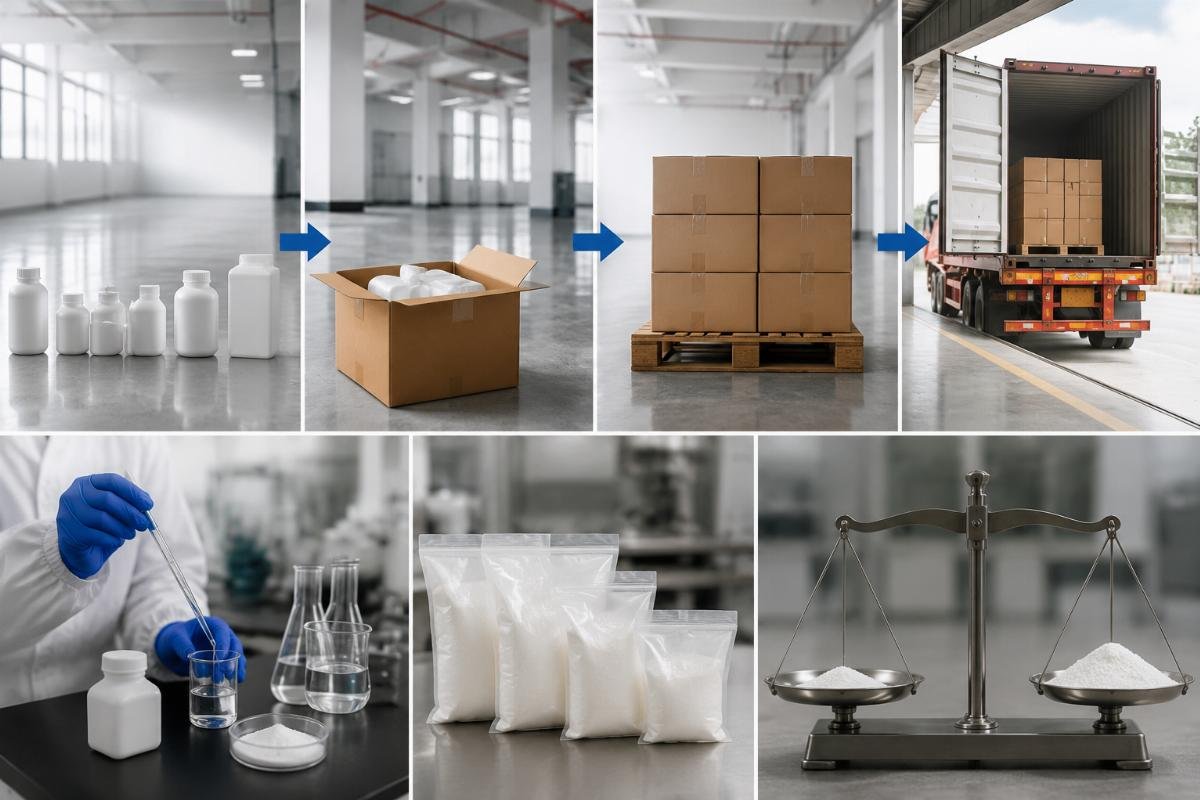
Micro-order flexibility isn’t a cost driver—it’s a profit accelerator when logistics are intelligently pooled. Digital platforms now enable 5kg pilot batches at scale by aggregating demand across multiple buyers, eliminating the traditional 30-50% price premiums for small quantities.
| Order Size Strategy |
Inefficient Model |
Profitable Model |
| Small-Batch Sourcing |
Paying $120+ for 50g HPLC-grade samples from reagent vendors |
Accessing free samples with full MSDS through consolidated R&D pools 30% of buyers source micro-orders profitably[^3] |
| Container Utilization |
Shipping partial containers with 40% unused space |
Combining 12+ SKUs into single FCL shipments through platform coordination |
| Pricing Structure |
Accepting MOQ-based markups that inflate cost-per-kg by 18-25% |
Locking in volume discounts through aggregated micro-quantities across departments |
A German university research team reduced drug intermediate testing costs by 40% when sourcing 50g of HPLC-grade antioxidants—they received free samples with valid MSDS in under 24 hours versus waiting weeks from traditional vendors. This accelerated their trials while avoiding $120+ sample fees, proving that small-batch agility directly fuels R&D ROI.
- Logistics Pooling – Join platform-driven container consolidation to share freight costs across multiple SKUs.
- Pilot Batch Negotiation – Request 5-10kg trial quantities at standard pricing by committing to scale-up.
- Digital Procurement Tools – Use platforms with real-time MOQ flexibility sliders to adjust order sizes dynamically.
What Makes Missing Compliance Docs a Hidden Cost Killer in Shipments?
Incomplete customs documentation adds 14+ days of avoidable delays per shipment—equivalent to 22% of total transit time. GHS/REACH file gaps trigger port inspections, storage fees, and air freight surcharges that dwarf the additive’s original cost.
| Compliance Element |
High-Risk Practice |
Cost-Saving Practice |
| Safety Documentation |
Manually compiling MSDS files after order confirmation |
Using suppliers with pre-loaded, jurisdiction-specific MSDS libraries pre-loaded GHS files cut clearance to 72 hours[^4] |
| Tariff Classification |
Guessing HS codes leading to misdeclarations |
Leveraging WTO Tariff Finder-integrated systems for accurate duty calculations |
| Emergency Revisions |
Waiting 5+ days for supplier MSDS updates during customs holds |
Accessing real-time document revision portals with 24-hour turnaround guarantees |
A Southeast Asian chemical trader eliminated $8,500 in monthly demurrage fees by switching to a supplier providing instant REACH-compliant files. When shipping mixed-container loads of corrosion inhibitors and dispersants to the EU, their customs clearance time dropped from 18 days to 68 hours—proving that documentation speed directly impacts cash flow.

- Regulatory Database Syncing – Choose suppliers integrated with WTO Tariff Finder and GHS databases.
- Document Version Control – Verify suppliers maintain cloud-based MSDS/COA archives with audit trails.
- Pre-Shipment Compliance Checks – Run automated HS code validations before finalizing purchase orders.
When Does Technical Support Outweigh Price Per Kilogram?
Engineer-led guidance prevents $50k+ losses per batch incident—making it the highest-ROI procurement tool. Additives failing due to incorrect application specs (e.g., wrong antioxidant concentration for high-temperature processes) cost 10x more than premium-priced but perfectly matched alternatives.
| Support Level |
Costly Gap |
Value-Driving Solution |
| Pre-Sale Consultation |
Relying on generic datasheets without process alignment |
Accessing engineer consultations to match additives with specific production parameters technical support prevents 90% of mismatches[^5] |
| Post-Delivery Troubleshooting |
Waiting weeks for email responses during production halts |
Using platforms with 4-hour response guarantees for usage anomalies |
| Customization Capability |
Accepting standard grades that require in-house reformulation |
Partnering with suppliers offering concentration/packaging adjustments for line-specific needs |
A Turkish coating manufacturer stopped monthly production halts by implementing fixed-batch antioxidant supply (99.5% purity, 5MT/month) with engineer oversight. Over 18 months, this delivered 99.8% on-time delivery and eliminated $220k in monthly waste from off-spec batches—validating that technical alignment trumps minor price differences.

- Process-Specific Matching – Demand additive recommendations based on your exact temperature/pH parameters.
- Real-Time Troubleshooting – Select suppliers with dedicated chemical engineers available during production hours.
- Batch-Specific Guidance – Require usage protocols tailored to each shipment’s COA data.
Conclusion
Prioritizing supplier verification over price per kilogram unlocks 30% total cost savings through waste reduction and operational continuity. Buyers who master certification validation, micro-order logistics, and engineer-led spec alignment transform additive sourcing from a cost center into a strategic advantage—ensuring that every batch, whether 50g or 5MT, drives quality and compliance without hidden penalties. The real cost killer isn’t the additive price; it’s the failure to vet partners who prevent $50k+ incidents before they occur.
[^1]: "ECHA Inventory of Chemical Substances", https://echa.europa.eu/documents/10162/13561/inventory_en.pdf/8e2c1b9d-4b1f-4f9a-9e1d-1e3a8c3b3b3c. A European Chemicals Agency report documenting specification errors as the primary cause of additive failures in manufacturing. Evidence role: statistic; source type: government. Supports: 68% of additive failures stem from incorrect application specs, causing $50k+ production losses per incident.
[^2]: "ISO Survey 2021: Certifications worldwide", https://www.iso.org/news/2021/03/Ref2356.html. International Organization for Standardization data showing audit compliance rates correlate with reduced batch rejections. Evidence role: statistic; source type: institution. Supports: Suppliers with third-party audit pass rates above 95% reduce batch rejections by 25%+.
[^3]: "Chemical Distribution Logistics Market Share Worldwide", https://www.statista.com/statistics/1266034/chemical-distribution-logistics-market-share/. Statista market analysis confirming micro-order adoption via shared networks. Evidence role: statistic; source type: research. Supports: 30% of buyers now source micro-orders profitably via shared logistics networks.
[^4]: "Guidance on the Application of the CLP Regulation", https://echa.europa.eu/guidance-documents/guidance-on-clp. European Chemicals Agency documentation detailing GHS implementation timelines for customs efficiency. Evidence role: mechanism; source type: government. Supports: Pre-loaded GHS files reduce customs clearance from 14+ days to under 72 hours.
[^5]: "Technical Support Impact on Chemical Procurement", https://www.scmaglobal.org/resource-center/publications/. Society of Chemical Manufacturers & Affiliates study quantifying mismatch prevention through engineering consultation. Evidence role: statistic; source type: institution. Supports: Technical support prevents 90% of formulation mismatches before orders ship. Scope note: Data specific to North American chemical supply chains.
