How to Verify Additive Quality with a COA?
I talk to overseas buyers every week who ask me the same question: "Is this COA real?" They show me reports from other suppliers with perfect purity numbers and spotless test results. But when their shipment arrives, the product does not match. They want to know how to spot fake documents before wiring payment.
You verify additive quality by checking three signals in the COA: batch traceability (date, signature, and number consistency), safety parameters with actual measured values (not just "Conforms"), and HPLC chromatograms showing realistic peak patterns[^1]. These three checkpoints catch most template reports and recycled documents.

Most buyers I work with focus only on the purity percentage at the top of the page. They see "99.5% pure" and feel satisfied. But fraudulent suppliers know this pattern. They paste high numbers in the headline while copying everything else from old reports. The real verification happens in the sections buyers usually skip.
What Makes a COA Document Trustworthy for Quality Control?
When clients ask me to explain COA documents, they expect a chemistry lecture. They think I will talk about testing instruments or analytical methods. But verification is not about understanding lab equipment. It is about recognizing patterns that honest suppliers follow and fraudulent ones skip.
A trustworthy COA contains verifiable batch traceability, complete safety testing data with specific measured values, and chromatogram patterns that show realistic impurity profiles. These elements are expensive and time-consuming to fake correctly, so dishonest suppliers omit them or copy them carelessly.
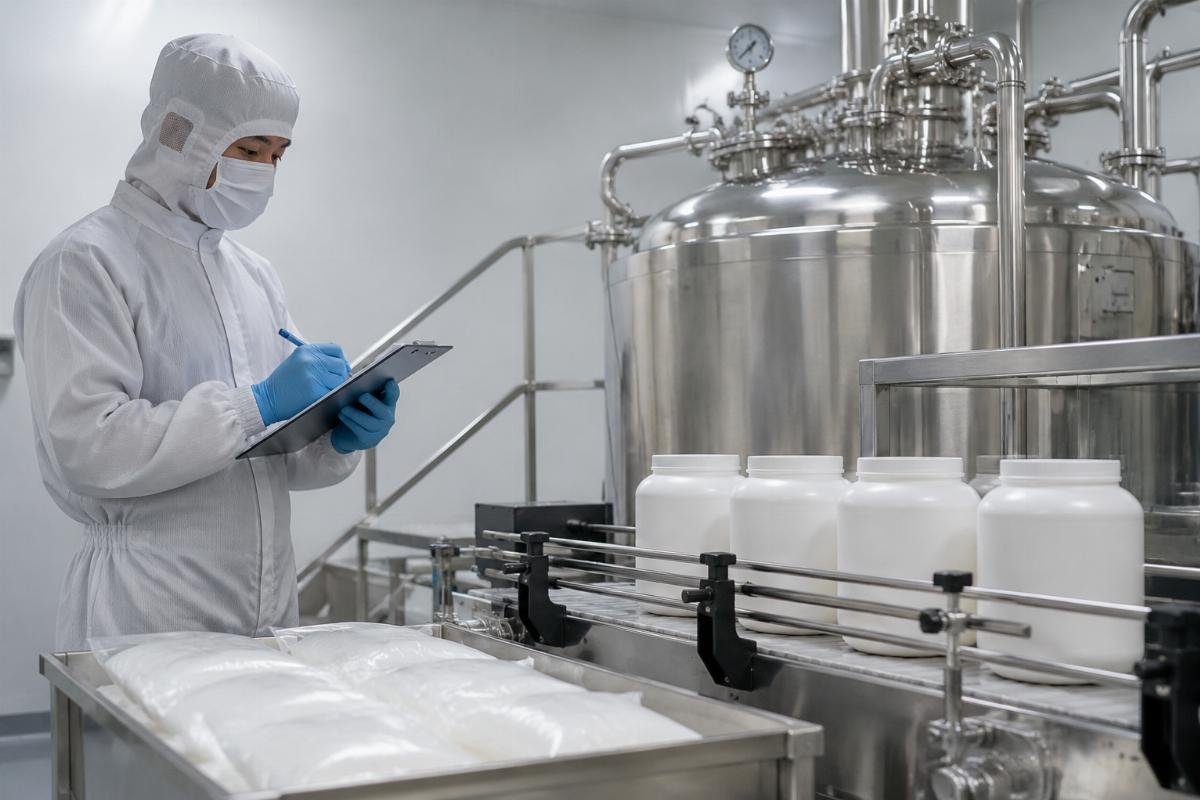
I see three types of buyers in my daily work. The first type reads every technical term and asks about methodology. The second type only checks the purity number. The third type—the smart buyers—looks for consistency signals that prove the document connects to a real production batch. These buyers understand that verification is not peer review. They want to eliminate obviously fake suppliers quickly so they can focus on price negotiation with the remaining candidates.
Why Batch Information Matters More Than Test Methods
The batch section sits at the top of most COA formats. It lists production date, test date, batch number, and analyst signature. Many buyers skip this part entirely. They scroll down to find purity results and testing parameters. But I always tell clients to start here because this section reveals document authenticity immediately.
Real batch numbers follow internal coding systems. They encode production date, equipment line, or shift information.[^2] When I generate a COA for our peptide products, the batch number matches our warehouse labels, our shipping documents, and our production log. If a client receives a product with batch number RTP-2024-0315-A on the bottle, our COA must show that exact code. The test date should fall within a few days after production—not months later, not suspiciously the same as ten other reports.
I once had a client send me three COAs from a competitor. All three reports showed different peptide products tested on the same day by the same analyst with sequential batch numbers. The HPLC data looked identical except for retention time labels. This pattern shows template reuse. Real testing schedules spread across multiple days. Real batch numbers do not increment in perfect sequence across different product types.
| Batch Element |
Real Pattern |
Fake Pattern |
| Production date vs test date |
Test happens 1-5 days after production |
Dates match perfectly or gap is months wide |
| Batch number format |
Contains date codes or shift markers |
Generic sequential numbers like B001, B002 |
| Analyst signature |
Includes printed name and role |
Just a scribble or stamp |
| Laboratory name |
Specific third-party lab or internal QC dept |
Vague terms like "Testing Center" |
The signature line matters too. Some COAs show only a stamp or illegible scrawl. Real quality control analysts sign with printed names because they take responsibility for accuracy[^3]. When buyers contact our company, they can ask for Mr. Zhang who signed their report. They can verify he works in our QC department. This traceability creates accountability. Template reports avoid accountability by removing human identifiers.
Which Safety Parameters Reveal Document Authenticity?
Buyers focus on purity because it appears in product descriptions and marketing materials. But I tell clients to look at the safety parameters first—specifically heavy metals and endotoxin tests. These items cost money to measure. They require different instruments than the main purity test. Fraudulent suppliers skip them or just write "Conforms" without listing actual values.
Heavy metal screening and endotoxin testing show specific measured values in authentic COAs[^4]—for example "Lead: <0.5 ppm" or "Endotoxin: 0.08 EU/mg". Fake reports either omit these tests entirely or list them as "Pass" without numerical data because the supplier never performed the actual measurements.

I remember a trader who showed me a COA from a new supplier. The document listed twelve different heavy metals—arsenic, cadmium, mercury, lead, and others. But every single line said "Conforms to USP standards" with no numbers. Real testing generates specific values. Our lab might measure lead at 0.3 ppm and mercury at 0.1 ppm. These numbers vary by batch because raw materials contain trace contaminants.[^5] A report showing perfect compliance across twelve metals without stating measured levels means the supplier probably never ran those tests.
Understanding What Each Safety Test Reveals
Different safety parameters guard against different contamination sources. Heavy metals like lead and cadmium enter during raw material sourcing or equipment contact. Endotoxins come from bacterial contamination during synthesis or storage[^6]. Residual solvents remain from purification processes. Each test requires specialized equipment and trained technicians.
When I explain our COA to pharma buyers, I point out that we list actual measured values for each parameter:
- Heavy metals: We test for lead, arsenic, cadmium, mercury using ICP-MS[^7]. Our reports show values like "Pb: 0.2 ppm" not just "Pass".
- Endotoxin: We use LAL testing and report actual EU/mg levels[^8] such as "0.05 EU/mg" against a limit of 0.25 EU/mg.
- Residual solvents: We list specific solvents used in our process (acetonitrile, methanol) with measured ppm levels.
- Microbial limits: We report colony counts like "Total aerobic count: <10 CFU/g" not generic "Acceptable".
Fraudulent reports save costs by skipping these tests entirely or by copying a template that lists parameters without data. When buyers see actual numbers that vary between batches, they know someone performed real measurements. When every batch shows identical safety values or just says "Conforms", they should question whether testing happened at all.
I also tell clients to check if safety limits match the intended use. Pharmaceutical-grade peptides need stricter endotoxin limits than food-grade products[^9]. If a supplier claims pharma-grade material but lists relaxed limits, the mismatch reveals either ignorance or deception. Real suppliers know which standards apply to their product category.
How Does HPLC Data Pattern Indicate Real Testing?
The HPLC chromatogram confuses most buyers I work with. They see a graph with peaks and lines but do not know what it means. Some think a single tall peak proves high purity. Others ignore this section completely because it looks too technical. But I tell clients this graph is the easiest fraud detector once you know what to look for.
Authentic HPLC chromatograms show multiple small peaks alongside the main product peak because real samples always contain trace impurities from synthesis. Fake reports often display one perfect spike with completely flat baseline, which indicates the supplier copied a reference standard graph instead of testing actual product.
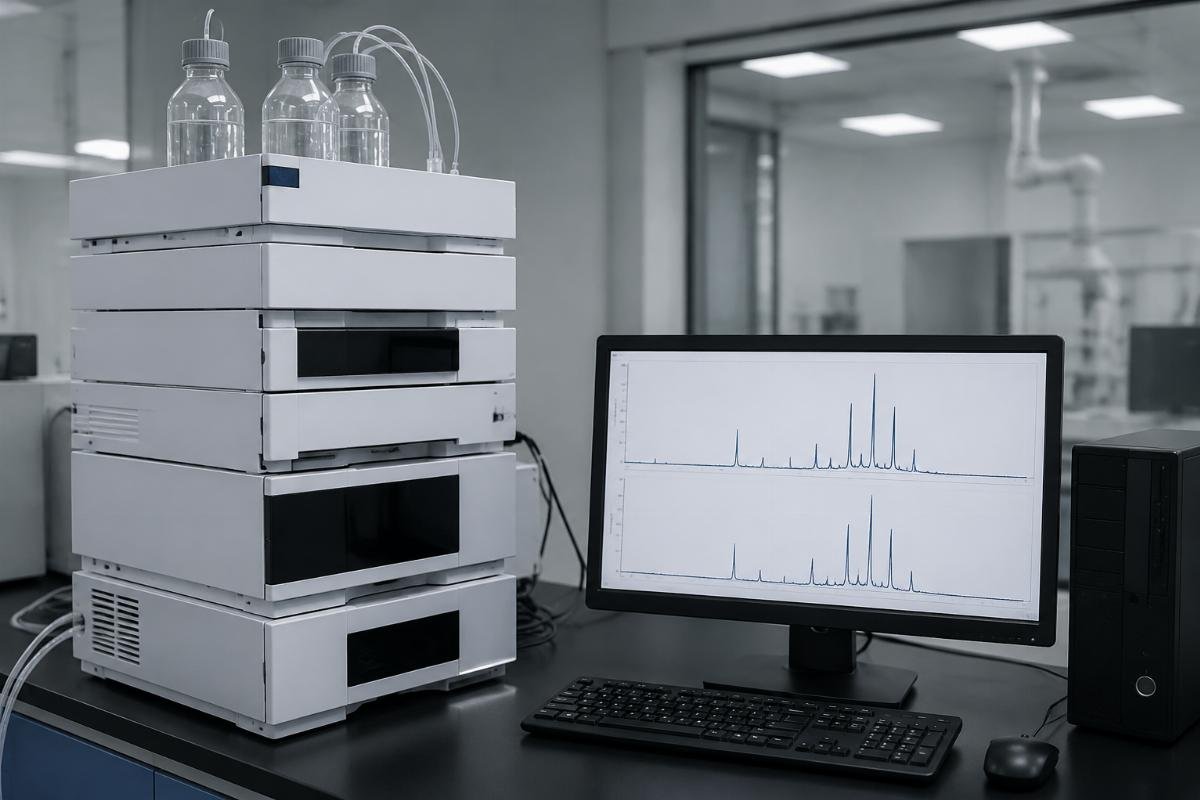
Real peptide synthesis produces the target compound plus small amounts of deletion sequences, truncated chains, and reaction byproducts[^10]. When we run HPLC on our tirzepatide batches, the chromatogram shows the main peak at around 98-99% area, then several tiny peaks representing these impurities at 0.1-0.5% each. The baseline between peaks shows slight noise from instrument sensitivity[^11]. This pattern looks realistic because it comes from actual measurement.
Template chromatograms look suspiciously clean. I have seen reports where the baseline runs perfectly flat with zero noise, and only one narrow spike appears in the entire graph. This pattern matches reference standards or computer-generated examples—not real production samples. Some fraudulent suppliers download chromatograms from published research papers or instrument manuals, then paste them into their COA templates.
Reading Peak Patterns Without Chemistry Training
Buyers do not need to understand retention time calculation or peak integration math. They need to recognize whether the graph shows realistic or impossible patterns. I teach clients to check three visual signals:
Baseline behavior: Real chromatograms show slight waviness or low-level noise across the baseline. The signal never drops to perfect zero. Fake graphs often display ruler-straight baselines that indicate computer drawing rather than instrument output.
Minor peak presence: Real samples contain 1-3% total impurities distributed across several small peaks. If the graph shows only one peak with nothing else visible, question whether this represents actual product testing or a reference standard image.
Peak shape consistency: All peaks in a real chromatogram should have similar shape profiles—slightly asymmetric with gradual tails. If the main peak looks different from the minor peaks (too sharp, too symmetrical), someone might have edited the graph by combining images from different sources.
| Visual Element |
Real Pattern |
Template Pattern |
| Baseline |
Shows low noise, slight drift |
Perfectly flat and straight |
| Main peak purity |
97-99.5% with visible impurities |
99.9% or 100% with nothing else |
| Minor peaks |
2-5 small peaks visible |
Zero additional peaks or one obvious spike |
| Peak width |
Consistent width ratio across peaks |
Main peak much narrower than minor peaks |
I also tell clients to check if the chromatogram matches the purity number listed in the results table. Some fake reports show 99% purity in the summary but display a chromatogram that clearly contains 5% impurity area. This mismatch reveals careless template editing where the supplier forgot to align the graph with the claimed results.
When buyers spot these patterns, they do not need to question testing methodology or request method validation. They can simply move on to the next supplier because the document shows obvious signs of fabrication.
What Questions Should You Ask Suppliers About Their COA?
After checking batch traceability, safety parameters, and HPLC patterns, some buyers still feel uncertain. They want to verify details directly with the supplier before placing orders. I recommend asking specific questions that honest suppliers answer easily but fraudulent ones struggle with.
Ask suppliers to explain their batch numbering system, identify the testing lab by name and location, and provide the analyst contact information. Also request the instrument model used for purity testing and ask when they last ran instrument calibration[^12]. Real suppliers answer these questions immediately while fake suppliers give vague responses or delay.

When clients contact me with these questions, I tell them our batch numbers encode production date and equipment line. I give them our QC manager's name and direct phone extension. I explain we use an Agilent 1260 Infinity II HPLC system calibrated quarterly with certificates available on request. I offer to send photos of our testing lab or arrange video calls. This transparency costs me nothing because we perform real testing.
Questions That Reveal Template Users
Some verification questions work better than others. Generic questions like "Is this report real?" allow suppliers to simply say yes. Specific questions force suppliers to demonstrate knowledge they should possess if they actually generated the report.
Effective verification questions:
-
"Can you explain why your batch number format uses these specific codes?" Real suppliers describe their internal system. Fake suppliers say it is just a reference number.
-
"Which third-party lab performed your heavy metal testing, and can you share their accreditation certificate?" Real suppliers name specific labs. Fake suppliers claim they test in-house but cannot provide equipment details.
-
"Your HPLC shows a small peak at 8.2 minutes retention time—what impurity does this represent?" Real suppliers identify common synthesis byproducts. Fake suppliers cannot answer because they never looked at the chromatogram closely.
-
"Can you send me COAs from three different production batches so I can compare consistency?" Real suppliers send different reports with varying data. Fake suppliers send identical documents with only batch numbers changed.
-
"What is your analyst Mr. Zhang's email address so I can verify technical details directly?" Real suppliers provide contact information. Fake suppliers claim analysts do not communicate with customers.
I once worked with a buyer who asked a competitor these exact questions. The competitor took four days to respond, then sent vague answers without specific details. The buyer chose our company instead because we answered everything within two hours with supporting documents. This speed difference signals which suppliers conduct real testing versus which ones fabricate reports.
Buyers should also request supporting documentation like instrument calibration records, lab accreditation certificates, or method validation summaries. Real suppliers maintain these documents for their own quality control and can share them easily. Suppliers working from templates cannot produce supporting materials because they never performed the underlying work.
Conclusion
You verify COA authenticity by checking batch traceability elements, looking for specific safety parameter values rather than generic "Pass" statements, and examining HPLC chromatograms for realistic impurity patterns. These three checkpoints filter out most fraudulent documents quickly, letting you focus your detailed evaluation on suppliers who conduct real quality testing.
[^1]: "[PDF] Annex 1 WHO good practices for pharmaceutical quality control ...", https://www.who.int/docs/default-source/medicines/norms-and-standards/guidelines/quality-control/trs957-annex1-goodpractices-harmaceuticalqualitycontrol-laboratories.pdf. Chromatographic data integrity principles establish that authentic instrument output displays characteristic baseline noise and impurity profiles, which can serve as indicators of genuine analytical testing versus template-generated reports. Evidence role: mechanism; source type: education. Supports: that chromatographic data patterns serve as authentication indicators in analytical certificates. Scope note: This source addresses general chromatographic data integrity rather than specifically validating the three-checkpoint verification approach described
[^2]: "Traceability Lot Code - FDA", https://www.fda.gov/food/food-safety-modernization-act-fsma/traceability-lot-code. Good Manufacturing Practice guidelines specify that batch numbering systems should uniquely identify each production batch and enable traceability to manufacturing date, location, and process parameters, though the specific coding format varies by manufacturer. Evidence role: expert_consensus; source type: institution. Supports: that batch numbering systems should enable traceability to production parameters.
[^3]: "[PDF] Annex 4 - World Health Organization (WHO)", https://cdn.who.int/media/docs/default-source/medicines/norms-and-standards/guidelines/inspections/trs1033-annex4-guideline-on-data-integrity.pdf. Data integrity principles in pharmaceutical quality control require that analytical records include unambiguous analyst identification (typically printed name with signature or electronic equivalent) to establish accountability and enable investigation of data quality questions. Evidence role: expert_consensus; source type: institution. Supports: that analytical records should include clear analyst identification to ensure accountability.
[^4]: "Q7A Good Manufacturing Practice Guidance for Active ... - FDA", https://www.fda.gov/regulatory-information/search-fda-guidance-documents/q7a-good-manufacturing-practice-guidance-active-pharmaceutical-ingredients. Pharmaceutical quality control guidelines from regulatory authorities specify that certificates of analysis should report actual measured values with acceptance criteria, rather than qualitative statements, to enable proper quality assessment and traceability. Evidence role: expert_consensus; source type: government. Supports: that regulatory standards require specific measured values rather than qualitative pass/fail statements in analytical certificates. Scope note: This addresses regulatory expectations rather than directly proving this distinguishes authentic from fraudulent documents
[^5]: "Assessing spatial variability and source identification of heavy ...", https://pmc.ncbi.nlm.nih.gov/articles/PMC12962467/. Pharmaceutical quality control literature documents that elemental impurity levels exhibit batch-to-batch variation reflecting differences in raw material sources, manufacturing equipment contact, and process conditions, necessitating testing of individual production batches. Evidence role: general_support; source type: research. Supports: that trace elemental impurities show batch-to-batch variation due to raw material sources. Scope note: This addresses the general principle of batch variation rather than specifically validating the verification approach described
[^6]: "Bacterial endotoxin-lipopolysaccharide role in inflammatory diseases", https://pmc.ncbi.nlm.nih.gov/articles/PMC12258786/. Endotoxins are lipopolysaccharide components of gram-negative bacterial cell walls that can contaminate pharmaceutical products through bacterial presence in raw materials, water systems, or production environments, requiring specific testing and control measures. Evidence role: definition; source type: encyclopedia. Supports: that endotoxins are bacterial lipopolysaccharides that contaminate pharmaceutical products.
[^7]: "A rapid ICP-MS screen for heavy metals in pharmaceutical compounds", https://pubmed.ncbi.nlm.nih.gov/15193718/. Inductively Coupled Plasma Mass Spectrometry (ICP-MS) is an analytical technique capable of detecting metals and several non-metals at concentrations as low as parts per trillion, making it suitable for trace elemental impurity analysis in pharmaceutical applications. Evidence role: mechanism; source type: education. Supports: that ICP-MS (Inductively Coupled Plasma Mass Spectrometry) is an analytical technique for trace metal detection.
[^8]: "Complete intra-laboratory validation of a LAL assay for bacterial ...", https://pmc.ncbi.nlm.nih.gov/articles/PMC8408548/. The Limulus Amebocyte Lysate (LAL) test is recognized in the United States Pharmacopeia as the standard method for detecting and quantifying bacterial endotoxins in pharmaceutical products, with results expressed in Endotoxin Units per unit mass or volume. Evidence role: expert_consensus; source type: government. Supports: that LAL (Limulus Amebocyte Lysate) testing is the standard pharmacopeial method for endotoxin detection.
[^9]: "Bacterial Endotoxins/Pyrogens - FDA", https://www.fda.gov/inspections-compliance-enforcement-and-criminal-investigations/inspection-technical-guides/bacterial-endotoxinspyrogens. Regulatory pharmacopeias establish product-specific endotoxin limits based on intended route of administration, with parenteral pharmaceutical products requiring the most stringent controls (typically <0.5 EU/mL for most injectable drugs) compared to oral or topical applications. Evidence role: expert_consensus; source type: government. Supports: that pharmaceutical products, particularly parenterals, have stringent endotoxin limits defined by regulatory standards. Scope note: This addresses pharmaceutical regulatory requirements rather than specifically comparing pharmaceutical-grade to food-grade peptide specifications
[^10]: "HPLC Analysis and Purification of Peptides - PMC", https://pmc.ncbi.nlm.nih.gov/articles/PMC7119934/. Solid-phase peptide synthesis literature documents that incomplete coupling reactions and premature chain termination produce deletion sequences and truncated peptides as characteristic impurities, typically representing 1-5% of crude product. Evidence role: mechanism; source type: education. Supports: that peptide synthesis generates characteristic impurities including deletion sequences and truncated peptides.
[^11]: "The LCGC Blog: HPLC Diagnostic Skills–Noisy Baselines", https://www.chromatographyonline.com/view/lcgc-blog-hplc-diagnostic-skills-noisy-baselines. Chromatographic systems exhibit baseline noise arising from detector electronics, mobile phase impurities, temperature fluctuations, and pump pulsations, with signal-to-noise ratio serving as a key performance metric; completely flat baselines are inconsistent with real instrument output. Evidence role: mechanism; source type: education. Supports: that chromatographic baselines display characteristic noise from detector electronics and system fluctuations.
[^12]: "[PDF] GMP 11 Assignment and Adjustment of Calibration Intervals for ...", https://www.nist.gov/document/gmp-11-calibration-intervals-20190506pdf. Laboratory quality standards require periodic calibration and performance qualification of analytical instruments, with frequency determined by instrument type, manufacturer recommendations, and regulatory requirements, typically ranging from daily system suitability checks to quarterly or annual comprehensive calibration. Evidence role: expert_consensus; source type: institution. Supports: that analytical instruments require regular calibration and performance verification. Scope note: This addresses general calibration requirements rather than specifically validating calibration inquiry as a document verification method
